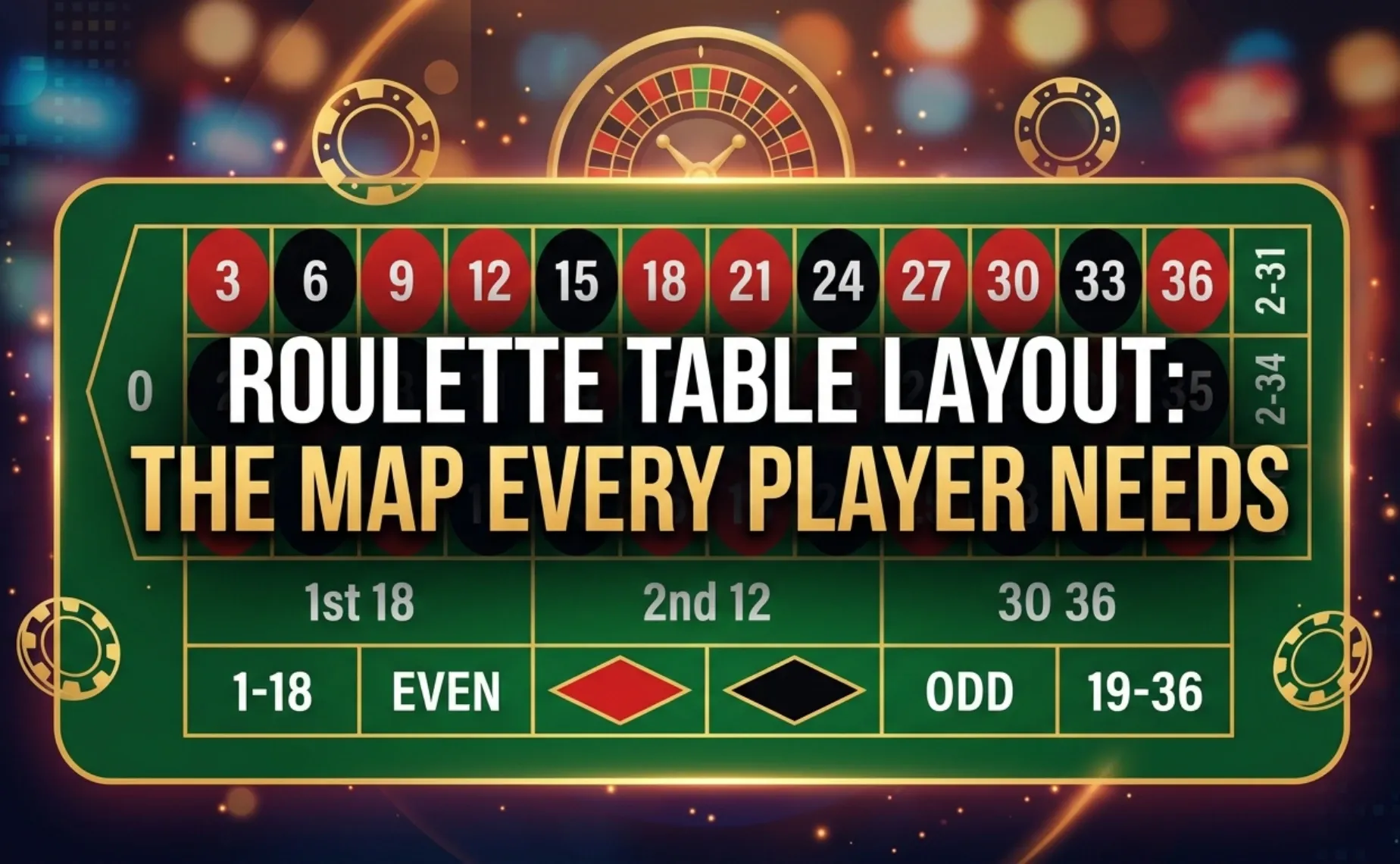
At first, the roulette table layout seems very complex; however, there is logic behind the placement of all the boxes and lines on the board. Knowledge of number placement and the meaning of all segments of the layout will help make sense of everything that is happening on the board. Whether you see the American, European, or French roulette board, there will not be many differences from the overall structure of the board.
What Is a Roulette Table Layout?
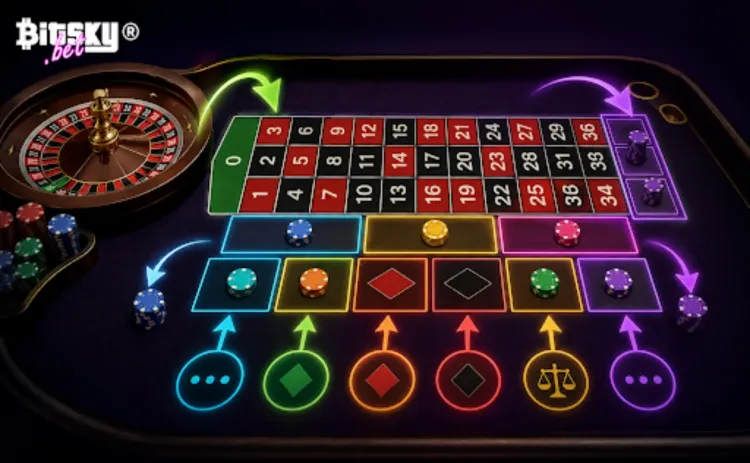
The roulette table layout can be found in a grid arrangement close to the roulette wheel, but it is not getting the attention that it should get from the players. There are numbers from 0 to 36 arranged in three columns of twelve rows each, with additional rows on the outside.
That single grid is doing two jobs. It displays every number on the wheel, and it offers faster ways to cover broad sections of the board without selecting individual digits. Once those two functions are separated, the layout reads far more clearly.
The structure holds steady across most tables. Regardless of whether it is a single zero wheel or a double zero wheel, the mapping is quite similar, which explains why one can learn to read just about any roulette board by memorizing only one.
Inside the Numbers Grid
Numbers 1 through 36 make up the inside section, each one boxed and colored red or black to match its spot on the wheel. This block carries most of the visual weight on the layout. At the top, colored green, sits the 0, joined by a second green box for 00 on American tables.
Inside plays cover this numbered grid directly. A straight play on a single number sits entirely inside one box. A split covers two neighboring numbers by placing a chip on the line between them. A street covers a full row of three numbers, a corner covers four numbers where their boxes meet, and a line covers six numbers across two adjoining rows. Each of these options exists because of how the boxes are physically arranged next to each other on the felt.
This is also where the roulette board differs slightly between versions. On a European or French layout, there is one green zero box at the top. On an American layout, there are two green boxes side by side, 0 and 00, which changes the house edge and adds a few extra grouping options near the top of the grid that European tables do not have.
Outside the Numbers: The Grouped Options
The outside section runs along the bottom and side of the numbered grid, and it covers ground fast. Red or black, odd or even, high or low, 1 to 18 against 19 to 36, each box here lets a player mark broad coverage with a single chip.
Two more groupings sit just below. The column boxes sit at the end of each of the three vertical columns. The dozen boxes split the layout into three ranges, 1 to 12, 13 to 24, and 25 to 36. Both options cover twelve numbers each, just grouped in different patterns across the board.
- Red or black, odd or even, and high or low each cover close to half the layout.
- Columns group numbers vertically, twelve per column.
- Dozens of group numbers in blocks of twelve, read left to right
These outside boxes exist purely for convenience. They do not represent anything new on the wheel itself, just a faster way to mark coverage across many numbers with a single chip placement, which is part of why new players tend to gravitate toward this side of the roulette table layout first.
American vs. European Table Layouts
Everyone talks about the two green pockets on an American wheel versus the single green pocket on a European one. That difference shows up on the printed layout too, not just the wheel. Check the top corner of an American table, and there's usually a five-number option sitting there, covering 0, 00, 1, 2, and 3 together. European and French layouts don't have this. No second zero means nothing to fold into that grouping.
French tables take this further by adding French-language labels directly onto the outside boxes. Manque and Passe replace low and high. Pair and impair replace even and odd. Rouge and Noir replace red and black. The physical grid of numbers stays the same, but the outside terminology changes, along with special call options like Voisins du Zero and Orphelins that appear on a separate racetrack-shaped section above the main layout on some tables.
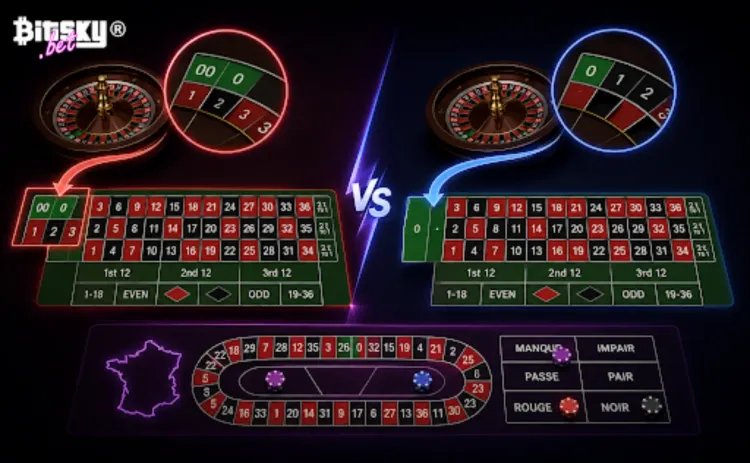
Knowing which version you are looking at matters because the extra zero on American tables changes the math slightly in the house's favor, even though the printed grid looks almost identical at first glance.
Want a closer look at how the two versions compare? Read our guide to European vs. American roulette.
Reading the Layout During Play
Once you know the sections, reading the table during actual play becomes a matter of habit rather than thought. You glance at the grid, decide whether you want tight coverage on a handful of numbers or broad coverage across a large section, and place your chip on the corresponding box or line.
Dealers are trained to help here too. If you are unsure whether your chip placement lands on a split, a corner, or a street, most dealers will confirm the play before the wheel spins. There is no shame in asking, and doing so early saves confusion once results start coming in.
Speed comes with repetition. The layout never rearranges itself, so the more sessions you spend looking at it, the faster your eyes find the section you want without scanning the whole board each time.
Playing Roulette on Bitsky
Bitsky brings this same familiar roulette table layout into a sweepstakes format, giving players a way to enjoy the game using Gold Coins for fun play or Sweeps Coins for a shot at real prize redemptions. The grid works exactly as described above, so any habits you build reading a physical roulette board carry straight over.
New players exploring roulette and the rest of the catalog can currently claim 20% off purchases, delivering 0.20 SC and 20,000 GC, using the promo code BONUS4U at checkout. It is a straightforward way to add extra coins to your balance while you get comfortable with the layout and figure out which sections of the board you enjoy playing most.
Conclusion
The roulette table layout looks like a lot from across the room. Up close, it's just numbers and boxes doing their job, inside for tight coverage, outside for the wider plays, with small shifts between American, European, and French tables. Learn the grid once, and every table after that reads the same way. That's really all it takes, and once it clicks, it stays clicked. Bitsky has a roulette waiting whenever you're ready to put it to use.
Reading the roulette table layout is your first step in understanding the board. Give it a try on Bitsky and use your knowledge in practice.
FAQs
What is a roulette table layout?
It's the printed grid sitting next to the wheel where players place their chips. Numbers 0 through 36 fill most of it, with extra boxes along the edges for grouped options like red, black, odd, and even.
What's the difference between an American and European roulette board?
American wheels carry a 0 and a 00. European wheels carry just the 0. That one extra pocket is the whole difference, and it's enough to nudge the odds toward European tables when you've got the choice between the two.
Can I play roulette on Bitsky?
Yes. Bitsky runs roulette in a sweepstakes format, so you can spin using Gold Coins just for fun or Sweeps Coins for a shot at real prize redemptions.
Is there a bonus for new roulette players on Bitsky?
Right now, new players can grab 20% off purchases, which comes out to 0.20 SC and 20,000 GC, just by entering the code BONUS4U at checkout.
Do I need experience to start playing roulette on Bitsky?
Not really. The board works the same way it always has, and once you know where the numbers and grouped options sit, jumping in and placing your first play takes no time at all.
Authored and Validated by: A Sweepstakes Gaming Expert