Blackjack gives you two moments where a single decision changes the entire hand: doubling your stake or splitting a pair. Most players guess at both, which is exactly where the dealer gains the edge. This blog covers double down in blackjack in full, including hand totals worth doubling on, the process behind the move, and when splitting works better than doubling. Every scenario comes from tested strategy odds, not guesswork, so you finish with a clear answer for the next strong hand or matching pair you are dealt.
What Does Double Down in Blackjack Mean
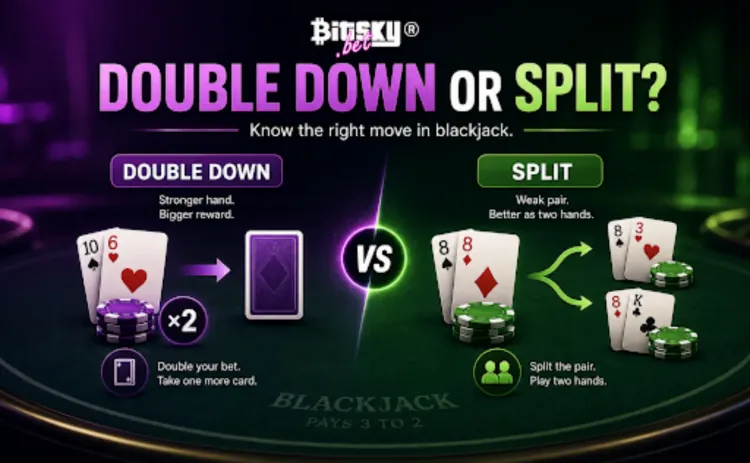
Double down in blackjack is the option to double your original wager right after your first two cards land, on the condition that you take exactly one more card and stop there. No hitting again, no backing out. You commit to that single card, whatever it turns out to be. Players reach for this move because some starting totals already sit in a strong position against the dealer's upcard.
Adding a stake to a hand that already favors you is how the extra card turns into extra profit instead of extra risk. Tables differ on how far this rule stretches. Some let you double on any two cards. Others cap it at totals of 9, 10, or 11 only. Reading the table's specific rules before you sit down matters here, since that one restriction can quietly shift the house edge by more than most players realize, a factor we break down further in our guide to blackjack odds.
How Doubling Down Works in Blackjack
The process itself is straightforward once you understand the sequence:
- You receive your first two cards and review your total against the dealer's upcard
- You place a second wager equal to your original one
- The dealer gives you exactly one more card, face down or face up depending on the table
- Your turn ends immediately after that card, regardless of your new total
- The dealer then plays out their hand according to standard rules
This is the sequence that defines double down in blackjack at nearly every table, sweepstakes formats included. The strategy behind it depends heavily on whether your hand is hard or soft.
Doubling Down on Hard Totals
Card values decide almost everything in this decision, so if hard and soft totals still feel unclear, our breakdown of card values in blackjack covers the basics first. Hard 11 first. No ace in the hand, or an ace worth just 1. This is the strongest total to double on, full stop. A ten-value card gives you 21. Anything else still leaves a hand that holds up against the dealer. Hard 10 is close to power, but only the dealer’s card value determines the probability in this case. Getting a 6 or less means that probability works for you. But any other card makes your doubled bet lose its advantage. Making a decision about the hard 9 is when reason prevails over intuition.
Doubling Down on Soft Totals
Soft totals include an ace counted as 11, such as a soft 17 made from an ace and a 6. These hands carry more flexibility because a low card cannot bust them. Doubling a soft 13 through soft 18 against a dealer's weak upcard is a recognized strategy move, since the ace protects you from busting even if the extra card is small.
When to Double Down in Blackjack
Knowing when to double down in blackjack comes down to comparing your total against the dealer's visible card rather than relying on a fixed rule for every hand. Strategy charts developed from millions of simulated rounds point to a consistent set of situations:
- Hard 11 against any dealer upcard except an ace
- Hard 10 against a dealer showing 2 through 9
- Hard 9 against a dealer showing 3 through 6
- Soft 16, 17, or 18 against a dealer showing 4, 5, or 6
Outside of these ranges, doubling usually works against you, since a weak total combined with only one extra card leaves too much room for the dealer to win.
What Is Splitting in Blackjack
Splitting in blackjack is a separate move available when your first two cards share the same value, such as two 8s or two queens. Rather than doubling your wager on a single hand, splitting divides the pair into two independent hands, each played with its own equal wager and its own set of additional cards. This turns one round into two full hands against the same dealer upcard, which can work strongly in your favor when the pair is a good starting point.
Not every matching pair is worth splitting. A pair of 5s, for example, totals 10, which is a stronger single hand than two separate hands starting with a 5 each. The value of the split depends entirely on which cards you are holding and what the dealer is showing.
When to Split in Blackjack
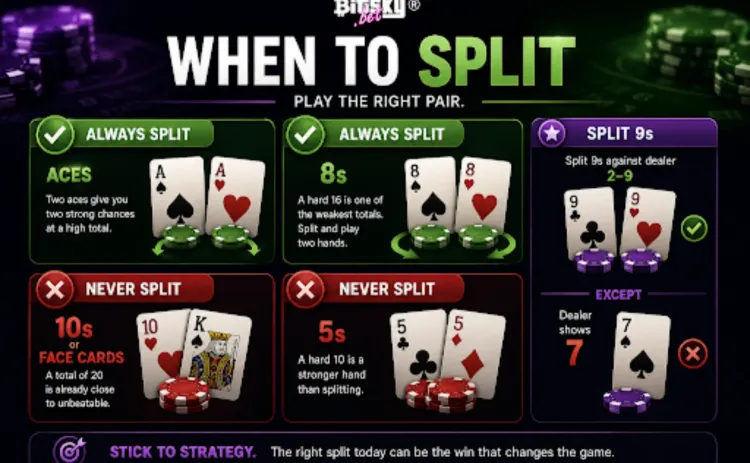
Deciding when to split in blackjack follows patterns nearly as consistent as doubling strategy:
- Always split aces, since two separate aces give you two strong chances at a high total
- Always split 8s, because a hard 16 is one of the weakest totals in the game
- Never split 10s or face cards, since a total of 20 is already close to unbeatable
- Never split 5s, since a hard 10 is a stronger single hand
- Split 9s against a dealer showing 2 through 9, except when the dealer shows 7
Following these patterns consistently, rather than splitting on instinct, is what separates disciplined players from those relying on guesswork.
Doubling Down Versus Splitting: When Each Move Applies
Deciding when to split in blackjack versus when to double down comes down to reading your pair's strength against the dealer's upcard, while doubling depends on your total after the first two cards. The two moves solve different problems:
- Doubling down works on strong single hands where one more card can push your total close to 21
- Splitting works on pairs that are individually weak but stronger when separated into two hands
- Doubling requires a hand that is not a pair, or a pair you have chosen not to split
- Splitting can sometimes be followed by doubling on one or both resulting hands, depending on the table rules
A pair of 8s illustrates the overlap well. Since a hard 16 is weak on its own, splitting turns it into two hands, and if one of those new hands starts strong, for example, an 8 paired with a 3, you may have the option to double down on that new hand as well.
Playing Blackjack on Bitsky
Every double down in blackjack decision made on Bitsky uses Sweeps Coins and Gold Coins rather than cash wagers, which keeps the game inside the sweepstakes format the platform runs on. This means you can practice the strategy outlined above, including when to split pairs and when to double your stake, using SC and GC picks rather than real money stakes.
Bitsky also offers several ways to build up coin balances beyond the games themselves:
A 20% bonus on purchases, giving 0.20 SC and 20,000 GC with the promo code BONUS4U
Task Rewards for completing platform activities
Spin the Wheel, available in Bronze, Silver, and Gold tiers, each offering different SC and GC prize ranges
Daily Rewards for returning players
A general Promo Code feature for ongoing offers
Up to 10,000 GC and 2 SC for completing KYC verification
Email and SMS opt-ins as additional ways to earn free Sweeps Coins
If you split your time between table games, the baccarat strategy guide covers the same kind of hand-by-hand decision-making for that game.
Conclusion
Blackjack outcomes depend on the decisions you make with each hand, not on habit. Double down when your total supports it. Split when the pair gives you better odds as two hands instead of one. Neither choice benefits from a fixed rule applied the same way every round. That distinction is the core of this guide, a way to read the table with more precision instead of relying on shortcuts. Bring that approach into your next hand, and you will notice the change in how you play.
Ready to put your blackjack strategy to the test? Sign up for Bitsky and practice your next double down or split decision with SC and GC.
FAQs
1. What does double down in blackjack mean?
It means doubling your original wager after your first two cards, on the condition that you take exactly one more card and nothing after that. The move only works when your starting total gives you a real shot at beating the dealer's hand.
2. What is the difference between doubling and splitting a pair?
Doubling raises your stake on a single hand you already hold. Splitting breaks a matching pair into two separate hands, each played and staked on its own. One strengthens a hand you have. The other creates a second chance out of a hand that would otherwise be weak.
3. Is it always worth doubling on a strong total?
Not always. A hand total that looks strong on paper can still lose if the dealer's upcard gives them better odds of landing a high total too. Strategy charts weigh both sides of the hand, not just yours, before calling a total worth doubling.
4. Can you double down after splitting a hand?
On most tables, yes. Once a pair is split in blackjack, each new hand is treated as its own separate deal, so if one of those hands starts strong, doubling on it usually follows the same rules as any other hand.
5. Where can you practice these decisions without real money on the line?
Sweepstakes platforms let you run through doubling and splitting scenarios using SC and GC picks instead of cash stakes, which gives you a low-pressure way to test strategy before applying it anywhere else.
Authored and Validated By: A Sweepstakes Gaming Expert