What actually decides a blackjack hand, the cards dealt or the choices made with them? Both, but not equally. The cards set the situation. What you do after is what actually changes the outcome. That's where blackjack odds come in. They explain why certain hands go the way they do, how much weight a dealer's up card really carries, and why one play beats another more often than not. This guide walks through those numbers plainly and what they actually mean once you're playing on Bitsky.
Understanding Blackjack Odds
A standard deck holds 52 cards across four suits. Every card dealt removes a possibility from what remains. That constant shift is the foundation of blackjack odds, which is why the cards still matter after the first two are dealt. The house edge fills in the rest of the picture. It's the mathematical edge the house holds over time. That number isn't fixed either. Table rules move it. So does how closely a player sticks to basic strategy. Put those figures side by side, and it gets a lot easier to see why some plays simply win out over others.
How Often Do Common Blackjack Hands Appear?
Card counting gets most of the attention when people talk about blackjack odds. It isn't required, though. Counting takes practice, sharp focus, a good memory, and more than most players ever bother building up. Learning the probability behind common hands is a lot simpler, and it still explains why one decision beats another.
Some hands appear often enough to be worth understanding. A natural blackjack, made with an ace and a ten-value card, is less common than an ordinary starting hand but still appears regularly. Starting pairs and strong opening totals such as 20 are also useful to recognize because they can change which decision makes the most sense. The exact probability depends on the deck and the point in the hand, so these figures should always be viewed in the context of the rules being used.
Soft Hands vs. Hard Hands in Blackjack
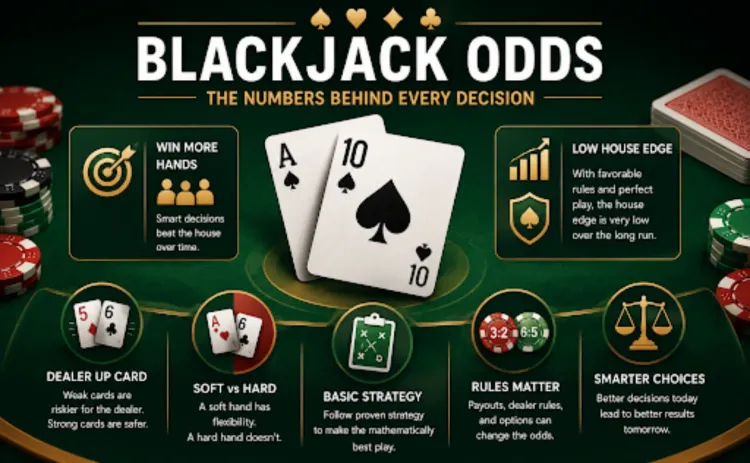
Start with the ace, since it's the whole reason "soft" and "hard" exist as terms at all. An ace can be worth 11 or 1, whichever keeps the hand under 21. When it's counted as 11, and the total still holds, that's a soft hand. An ace and a 6, for instance, give you a soft 17.
Take that flexibility away; either the ace has to drop to 1 because 11 would bust the hand, or there's no ace to begin with, and what's left is a hard hand. No second option to fall back on if the next card runs high.
What Are the Odds in Blackjack of Winning a Given Hand?
Under common rules and optimal basic strategy, players win somewhere around 42% to 43% of hands. Some end in a push instead. The exact number shifts with the rules in play, the deck count, and whatever else the table happens to be running.
Turn order structures the entire advantage. A player who busts loses right away, before the dealer even finishes playing. It doesn't matter if the dealer would have busted too. This turn order, more than anything else, is what keeps the house edge in place.
How Deck Count Changes the Numbers
Fewer decks can slightly improve the player's mathematical position, but deck count is only one part of the equation. Six- and eight-deck shoes tend to run a slightly higher house edge, even with otherwise similar rules. More cards in circulation means each individual card carries less weight on what's left in the shoe.
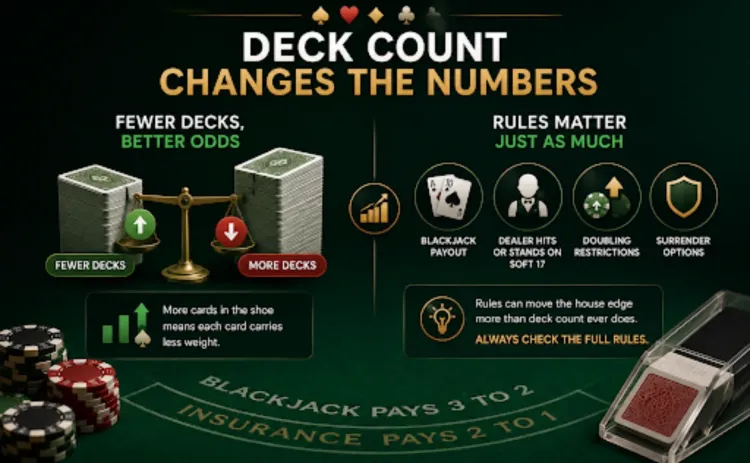
Table rules matter just as much, sometimes more. Payout on a natural blackjack. Whether the dealer hits or stands on soft 17. Doubling restrictions. Surrender options. Any one of these can move the house edge more than the deck count ever does on its own. That's the real reason to check the full rule set before sitting down, not just count the decks in the shoe.
Why Insurance Stakes Rarely Favor the Player
When a dealer shows an ace, players get the option to place an insurance stake that the dealer has blackjack. It sounds like protection. Mathematically, it rarely is. Mathematically, it rarely is. Insurance only pays off when the dealer's hidden card is a ten-value card, which happens roughly 30% of the time given a standard deck composition. That is well below the roughly 33.3% probability needed for a 2:1 payout to break even.
Probability in Blackjack and the Dealer's Up Card
Probability in blackjack doesn't hold still, and nowhere is that more obvious than the dealer's up card. Take a 5 or 6. Bust probability climbs to roughly 42% with either card showing. With a 9, 10, or ace showing, the dealer's bust probability drops considerably because the starting total is stronger.
Averaged across a full shoe, dealer bust probability lands around 28%. That single number hides more than it reveals, though, since the real spread between a weak up card and a strong one is where basic strategy actually gets its edge. Knowing which side of that gap you're on changes the correct play more than any other single factor in the hand.
Rule Variations That Shift the Odds
A handful of rule differences can swing blackjack odds more than most players expect. A few worth checking before sitting down:
- Payout on a natural blackjack: 3 to 2 favors the player; 6 to 5 raises the house edge substantially.
- Dealer action on a soft 17: standing favors the player slightly more than hitting
- Doubling down after a split: allowed rules favor the player
- Surrender option: lets a player forfeit half a stake on a clearly losing hand rather than playing it out
Checking these details before committing to a table puts a player ahead of most others sitting down cold.
Common Blackjack Variants Worth Knowing
Not every blackjack table plays by the same rules. Step outside the standard version, and the odds move around more than you'd expect, sometimes helping the player, sometimes not.
- Spanish 21 strips every 10 out of the deck. Rough deal on paper. But the payout bonuses and extras like late surrender and doubling after a split make up the difference, and then some
- European blackjack only shows one dealer card at first. The second comes later, after players have already acted, so there's no reading a hidden card here
- Double Exposure flips both dealer cards face up from the start. Sounds generous, and it is, which is exactly why the payouts get trimmed to balance things out
- Blackjack Switch hands players two hands and lets them trade cards between the two. One catch: a dealer total of 22 just pushes instead of busting
Mistakes That Quietly Widen the House Edge
Knowing basic strategy doesn't guarantee it gets followed. Even experienced players fall into habits that cost them, often without noticing. Standing too early on a soft hand is one. Taking insurance out of routine, rather than by the numbers, is another. So is settling into a table with payout rules that quietly favor the house more than usual.
Chasing losses by increasing stake size erratically does not change the underlying math either. Blackjack odds stay the same hand to hand regardless of how much was won or lost previously, since the cards have no memory of prior outcomes.
Basic Strategy and Improving Your Odds
Memorizing a counting system is not required to see real improvement. A solid basic strategy chart, followed consistently, brings the house edge down close to its theoretical floor by removing emotional decisions from the equation.
Players who consistently make basic strategy mistakes can face a noticeably higher house edge. Historical research has estimated the cost of player errors at around 1.4% on average, although the exact impact depends on the rules and the decisions being made.
Bankroll Considerations Tied to the Odds
Blackjack odds only tell part of the story. Variance fills in the rest. A low house edge is not a guarantee, not for any single session, since short-term results can swing well past what the long-term average would suggest.
That's exactly why a session limit set in advance matters more than most players think. Decide it before sitting down, not mid-shoe. It keeps a player within a comfortable range no matter how that particular shoe runs.
Playing Blackjack on Bitsky
Bitsky brings this classic card game into its social sweepstakes lineup, giving players a chance to apply everything covered above while exploring the platform's broader rewards system. New players can currently claim 20% off purchases, receiving 0.20 SC and 20,000 GC, using promo code BONUS4U at signup.
More Ways to Earn on the Platform
Beyond the welcome offer, Bitsky gives players several other ways to build up their coin balance over time, some passive and some tied to specific actions on the platform.
- Task Rewards: extra GC and SC for completing simple in-platform actions
- Spin the Wheel: Bronze, Silver, and Gold tiers, each with its own SC and GC prize pool, with Gold offering the strongest potential payout.
- Daily Rewards: a steady trickle of bonus coins just for logging in
- Promo Code feature: lets players redeem additional codes as new ones are released
- KYC verification bonus: up to 10,000 GC and 2 SC as a one-time bonus, worth completing early for regular players
- Email and SMS updates: players who opt in typically hear about new promo codes and wheel prize changes before they appear anywhere else on the site.
Conclusion
Understanding blackjack odds won't guarantee a winning session. It does make the decisions inside that session easier to evaluate. Dealer up cards. Table rules. Basic strategy. Hand probabilities. Each one shapes the mathematical picture a player is actually working with. None of it is about predicting outcomes hand by hand. It's about knowing why one decision holds up better than another, and playing accordingly.
Ready to take your blackjack knowledge further? Learn how each card affects your decisions and strategy in our guide to the value of cards in blackjack.
FAQs
1. Is blackjack mostly based on luck?
Blackjack runs on both luck and decision-making. The cards you're dealt are random. What you do after isn't, and that part actually shifts the math in your favor or against it. That's the whole case for basic strategy. It won't guarantee a win, but it puts the odds where they're supposed to be.
2. Does the number of decks in play affect my chances?
Yes, it can. Games with fewer decks can give the player a slightly better mathematical position when the other rules are the same. Six- and eight-deck games are also common, but the number of decks is only one part of the overall house edge. The payout and table rules matter too.
3. Is basic strategy really necessary or just a helpful suggestion?
It is close to essential for anyone chasing the best realistic outcome. Strategy charts come from probability calculations, not opinion, and following them consistently narrows the gap between player and house.
4. How does the dealer's up card affect probability in blackjack?
It changes almost everything about how the hand should be played. Show a weak card, a 5 or 6, and bust probability jumps. That's exactly why strategy charts push more aggressive plays against those two cards specifically.
5. Can new players use blackjack odds to their advantage right away?
New players don't need to wait to see the benefit. Basic hand probabilities alone sharpen decision-making from hand one. Enjoying welcome offers and ongoing bonuses in the mix, and there's more reason than ever to put that knowledge to work early.
Authored and Validated by: A Sweepstakes Gaming Expert