Ever wondered why the odds always appear to be in favor of the platform in the end? It's because of the 'house edge,' even though you might come out winning during your session. Most players have heard the term. Not many actually know what it means, and that gap is where confusion around wins and losses comes from. So here's the straight version. What it is, how it gets calculated, why it moves from game to game, and what any of it actually means for your time spent spinning on Bitsky.
What Is House Edge
It is a built-in mathematical advantage. Every game has one. It's expressed as a percentage, and it represents what a platform keeps on average from total stakes over a long stretch of play. Suppose a game has a 5% house edge. For every hundred credits wagered across thousands of rounds, five stay with the platform on average. However, this does not necessarily imply that you will lose money playing tonight. Randomness plays a major role in staking, and it starts to appear only when you play thousands of games.
How Does It Work
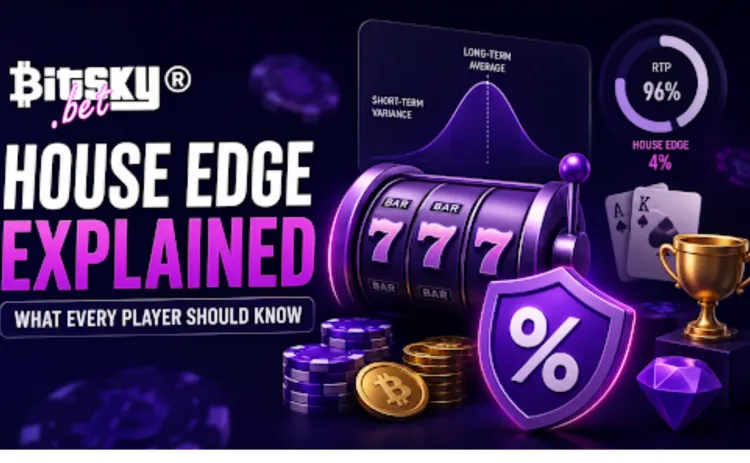
This and RTP, short for Return to Player, are basically two ways of describing the same thing. A slot with 96% RTP has a 4% house edge. Simple math. These numbers come from the game's programming and get tested by independent labs before anything goes live, which is why licensed platforms can just publish them outright. Developers set these figures to balance fun with sustainability. Low edge feels generous, for sure, but the platform still needs margin somewhere to keep things running and fund bigger prizes elsewhere.
Here's the part people miss. RTP gets calculated across millions of simulated rounds, not the twenty spins you might run tonight. Two players can play the same game on the same night and come out with totally different results. The published RTP is a theoretical average, only accurate once the sample size gets big enough to smooth out the noise. Your experience on any given day looks nothing like that long run number. It could be better or maybe worse.
House Edge Across Popular Games
Different games carry different edges depending on design and volatility.
- Classic slots usually land between 2 and 8%, with high volatility titles trending toward the top of that range
- Table-style games like blackjack variants can drop below one percent with optimal strategy
- Progressive style games tend to run a slightly higher edge since part of every stake feeds the growing prize
Simpler games with flat payouts often carry smaller, steadier edges compared to games chasing one big jackpot moment
Why It Matters for Your Play
Knowing a game's house edge changes how you play it. Want longer sessions? Lean toward lower-edge games where your funds stretch further. Chasing one big moment instead? A higher edge might be worth it for bigger swings and bigger potential rewards. Neither approach is wrong. But playing without this context means you're flying blind. It won't tell you what your next ten rounds look like. It just gives you an honest read on what to expect if you play a game consistently over time.
This also clears up a common myth, the idea that a game is due for a big result after a cold streak. It isn't. Every round gets calculated independently. It is a pattern that only shows up across a large volume of play, never a signal that your next spin owes you something. Players who get this tend to make calmer choices and actually enjoy their sessions more, mostly because they've stopped chasing a pattern that was never really there in the first place.
Tips for Playing Smarter
Following these steps can help players make a smart decision ahead.
- Check the RTP or house edge listed before you start playing a new game
- Set a session budget ahead of time so results stay something you observe, not something you chase
- Mix in lower-edge games if you'd rather play longer, steadier sessions
- Treat every round as its own thing, since nothing before it changes what happens next
Bitsky players can extend their sessions further with code BONUS4U. It unlocks 20% off purchases plus 0.20 SC and 20,000 GC, which means more room to try different games while keeping all these aspects in mind.
Conclusion
This term isn't some trick hiding in the fine print. It's not a warning sign either. It's just math, the same math that keeps games funded and prize pools growing. Once that clicks, game choice gets easier. Budgets get smarter. And you walk into a session already knowing what to expect instead of hoping for the best. Use a promo code at Bitsky and extend the gameplay with a minimum balance.
Looking for longer sessions? Explore Bitsky's lower house edge games today.
FAQs
1. What is RTP in sweepstakes platforms?
The return to player is the percentage of all wagered money that a slot machine is programmed to pay back to players over time.
2. Does volatility play into house edge at all?
Slightly, but they're not the same measurement. Volatility tells you how often and how big the wins hit. It tells you what gets held back on average over time.
3. Is a lower edge always better?
For longer sessions, usually. Less of your stake gets held back over time. The trade-off is that peak rewards tend to be smaller, too.
4. Does "house edge" mean the player is guaranteed to lose?
Not even close. It's a long-run average across thousands of rounds. Any single spin can go either way and often does.
5. Can the edge shift mid-session?
No. It's baked into the game itself. It doesn’t matter how long you've been playing or what your last few rounds looked like; it stays put.