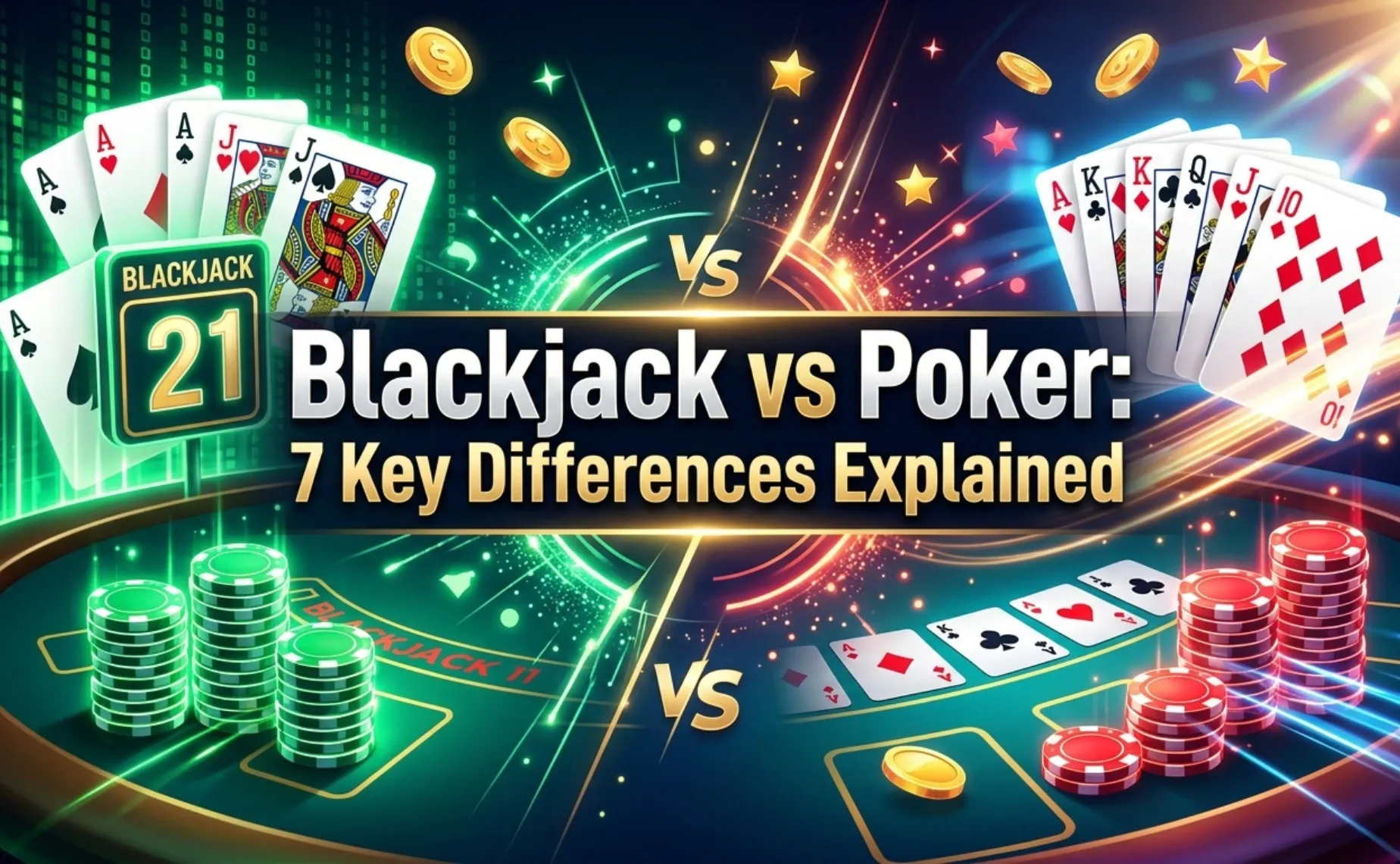
Blackjack and poker often sit side by side in the same lobby. Different games, though, right down to the math. Blackjack's odds are fixed before you ever sit down, set by deck count and dealer rules. Poker isn't fixed at all, since you're reading a table full of people, not a printed rule sheet. That's the starting point for 7 differences of blackjack vs poker worth knowing before you pick a table, covering speed, skill, and how much the person next to you actually matters.
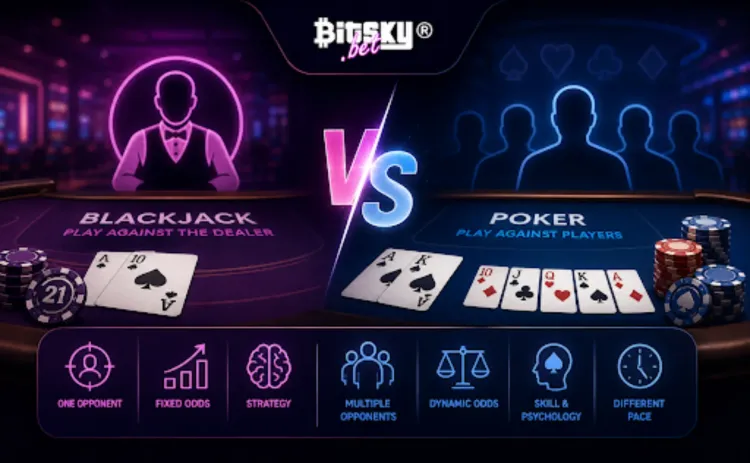
1. Who You Are Actually Playing Against
Blackjack narrows the field to a single opponent: the dealer. Whether the player beside you hits on 16 or stands on 12 has no bearing on your own result. The outcome rests entirely on your cards, the dealer's up card, and the specific rules that the table runs, down to details like whether the dealer stands or hits on a soft 17.
Poker throws that isolation out the window. Every single player still holding cards is part of the equation. Pocket kings lose to garbage hands more often than you'd think, simply because the other player wouldn't let go. And plenty of pots go to a hand that shouldn't have won anything, purely because everyone else at the table decided the risk wasn't worth it.
It is a fact that the dealer only makes everyone compete at the table, sitting at the root of nearly every other difference in this blackjack vs poker comparison. So keep it in mind as the rest of the list unfolds.
2. The Math Behind the Odds
Run the numbers on a blackjack table, and you get a fixed answer. Deck count, dealer rules, doubling restrictions, even the payout ratio on a natural, 3 to 2 versus the weaker 6 to 5, all of it rolls into one calculable edge before a single card gets dealt. Basic strategy charts exist for exactly this reason. Apply one correctly, and that edge drops to well under half a percent, holding steady no matter which table you sit at, aside from whatever rule variations that specific table runs.

Poker never gives you a fixed number. You're not up against a printed rule sheet. You're up against people, and people adjust, bluff, and occasionally hand you an edge just by making a bad call. The same starting hand can carry very different odds depending on who's still in the pot. It comes down to how those opponents tend to play under pressure. Against a table of cautious players, that hand is a near lock. Against a table where nobody wants to fold, it's closer to a coin flip.
Fixed math against shifting human behavior. That contrast is exactly why so many players search for a clear blackjack vs poker explanation before deciding where to spend their session. Under correct basic strategy, blackjack typically runs a house edge between 0.5% and 1%, depending on the specific table rules. Poker carries no comparable number at all, since the game isn't played against a fixed edge but against opponents whose decisions shift the math hand by hand. That's a meaningful distinction for anyone weighing return against effort before choosing a table.
3. Skill Matters, But Differently in Each Game
Neither game is pure luck, and neither is pure skill either. Where they diverge is in how quickly that skill ceiling gets reached and how long it keeps paying off. Blackjack rewards memorization. Learn the strategy chart correctly, and your decisions stop varying almost entirely, since the same 16 against a dealer 10 always calls for the same response. Poker rewards something closer to judgment instead.
Reading a situation correctly matters more than memorizing a chart, since the same two cards can call for different plays depending on who else is in the hand. Short sessions of either game can be dominated entirely by chance, so a single strong or weak night rarely proves much on its own. Poker's skill edge grows the longer you play. It often takes thousands of hands before that edge becomes obvious.
Blackjack works differently. Its edge stays roughly the same size no matter how experienced a player gets, since the math itself never moves. Look at who actually wins poker consistently over time, and it's usually the same names again and again. That pattern says more about skill than any single upset a newer player might catch online.
4. Speed of Play
A blackjack hand rarely takes more than a minute from deal to payout. That pace holds steady whether the table is packed or nearly empty, since nobody is waiting on anyone else's turn for long. Dozens of hands per hour is normal, and some fast tables push that number even higher.
Poker takes its time. Multiple rounds of decisions, community cards, and player turns stretch a single hand out considerably, especially once several players stay in through the later rounds. Online tables move faster than a physical room ever could, and quicker formats exist for players who want speed without giving up the game entirely, but even the fastest online poker still moves slower than blackjack by design.
That gap in pace is one of the more practical parts of any blackjack vs poker decision, since it directly affects how much you can fit into a short session versus a longer one.
5. How Much the People Around You Matter
Reading opponents is the whole point of poker, even online where you cannot see a face. Wager sizing, timing, and the speed someone acts on a strong hand versus a weak one, it all adds up to information over time. Piecing that profile together is arguably half the game. Plenty of experienced players will tell you it matters just as much as the cards in front of them.
Blackjack has no equivalent layer. The dealer follows fixed rules with no room for interpretation, and other players at your table have zero bearing on your outcome no matter how they play their own hands. It is, in practice, a solitary game dressed up as a social one, which some players prefer precisely because there is nothing external to manage.
If you enjoy the psychological side of gaming, poker delivers that in a way blackjack simply cannot. If you would rather keep your attention on your own cards without worrying about anyone else, blackjack is built for exactly that, and that difference alone settles the blackjack vs poker question for a lot of players.
6. How Stakes Move Through a Hand
In blackjack, the wager goes down once, before a single card is dealt, and the hand plays out from there in one straightforward step. Doubling and splitting bring in a bit of flexibility, letting you add to your stake mid-hand under the right conditions. Beyond that, though, the structure stays simple.
Poker stretches the same decision across multiple rounds. New cards appear, and with them comes another chance to raise, match, or walk away entirely. A stake that started small can grow considerably by the final round or shrink to nothing the moment someone decides the hand is not worth chasing any further.
That layered structure helps explain why poker sessions feel unpredictable in a way blackjack rarely does. If you're weighing where to put your stake first, it's worth knowing Bitsky currently runs a 20% off promotion on purchases, giving 0.20 SC and 20,000 GC through code BONUS4U, useful whether you land at a blackjack table or a poker room.
7. What It Takes to Actually Get Good
Basic strategy can be learned in an afternoon. Once it is memorized, a blackjack player's decisions barely change from one session to the next, since getting better mostly means getting more consistent, not more creative.
Poker never really stops teaching. Starting hand ranges take a weekend to learn, but reading opponents, managing a stake across a long session, and adjusting table by table can take years to sharpen. No chart solves poker the way basic strategy solves blackjack, which is part of why long-time players still find new things to work on. Even players who have logged thousands of hands will tell you a new table can still surprise them, which is not something you hear often from someone who has spent the same amount of time at a blackjack table.
That gap in how each skill ceiling behaves is one of the clearest ways to settle a personal blackjack vs poker preference. Want something you can master quickly and repeat forever? Blackjack does that. Want a game that keeps handing you something new to learn every session? Poker rarely runs dry.
Choosing Between the Two on Bitsky
Fast, fixed odds, and low mental overhead: blackjack fits players who want exactly that. Longer sessions, opponent reading, and strategy that keeps evolving: poker fits players chasing something deeper. Blackjack works well for a quick session, something to open with or fill a short break. Poker suits a longer stretch once there's time to actually settle in and pay attention. Neither game beats the other outright. Blackjack rewards fast, confident math. Poker rewards reading the table and adjusting as a session unfolds.
Think about how you actually spend your time before locking in a preference. Someone who plays in short bursts between other tasks will usually get more out of blackjack, where a session can start and finish in a few minutes without leaving anything unresolved. Someone with a longer stretch of free time and a genuine interest in outthinking other players rather than a printed rule sheet tends to get more long-term satisfaction out of poker. Neither preference is fixed forever either, and plenty of regular players change their answer depending on the day.
Conclusion
What matters most in the blackjack vs poker choice is what you actually want out of a session. Blackjack hands you fixed, calculable odds, and rewards a quick, confident call. Poker asks for patience instead, along with a read on the people sitting across from you, and that skill only gets sharper with time. One game is about playing the numbers. The other is about playing the table.
Discover your next favorite table game on Bitsky.
FAQs
1. Is blackjack easier to learn than poker?
Largely, yes. Every blackjack hand has one correct play, and that chart takes an afternoon to memorize. Poker takes longer. Opponents change, so the "right" play shifts with them instead of sitting fixed on a page.
2. Which game has better odds, blackjack or poker?
Blackjack's edge is fixed and shrinks with correct strategy, staying consistent no matter who else is at the table. Ask the same question about poker, and there's no clean answer, since your odds depend entirely on who you're sitting across from. That's part of why the blackjack vs poker odds comparison never has a single winner.
3. Should a beginner start with blackjack or poker?
Either works. Blackjack tends to feel friendlier at first since the rules never move and hands finish fast. Poker asks for more patience early on, mostly because reading people takes longer to learn than a strategy card.
4. Does luck matter more in blackjack or poker?
In the short term, blackjack leans harder on luck. Each hand plays out against fixed rules with no room to adjust mid-hand. Poker settles down over a longer session once skill and opponent reading start doing more of the work than the cards themselves.
5. Does the Bitsky promo code apply to both games?
It does. BONUS4U works platform-wide, so the 20% off, 0.20 SC, and 20,000 GC apply no matter which table you sit down at first.
Authored and Validated by: A sweepstakes expert