Casino
 Rips
A slot screen lists 95.8% somewhere in the game info, and most players scroll right past it. That small figure drives the math behind every round. This guide explains what is RTP in casino games and why so many people interpret it as a prediction tool even though it was never designed to be one. All it takes is one formula and one example to understand it.
RTP Meaning: A Plain Overview of the Percentage
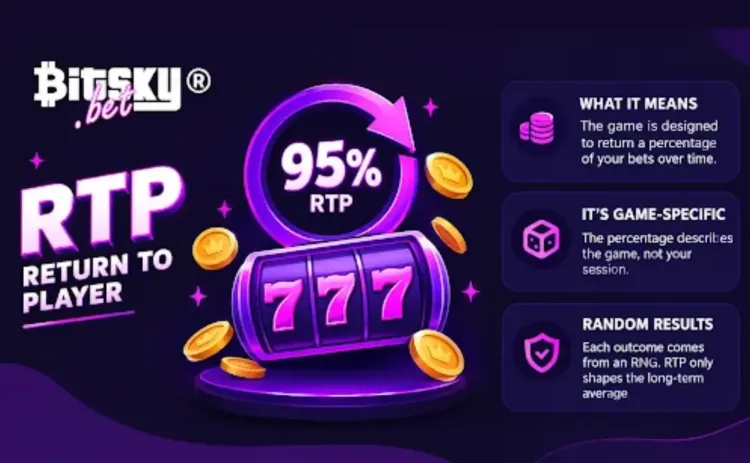
RTP stands for return to player. It is the share of all coins played on a game that the game is designed to give back over a very large number of rounds. A game listed at 95% is built to return 95 coins for every 100 played, on average, across the long run. The other 5 stay with the game.
Anyone looking up the RTP meaning should hold on to one detail: the percentage describes the game, not your evening with it. It is fixed in the design before the first round is played. Each outcome comes from a random number generator, which Bitsky explains in its guide to what RNG is and how it works. The generator decides every result. RTP only shapes the average those results drift toward over time.
Common Questions About RTP Percentages
A few questions come up again and again.
- “It hasn’t returned much lately. Is it due?” No. Every round is generated on its own, so a quiet run doesn’t raise the next result.
- “My session came out far below the listed percentage. Is the figure wrong?” Rarely. A single session is a tiny sample, and the Results section below shows why.
- “Does a bigger balance or a different hour change the RTP?” Neither does. The figure belongs to the game.
- “Does a high RTP mean frequent returns?” Not on its own. How often returns arrive is a separate measure, covered in our hit frequency guide.
Why Understanding the RTP Percentage Helps Players
Understanding the RTP percentage won’t change a single round. It does change how you choose a game and how you read a session.
- You can compare two games using a number instead of artwork or theme.
- You set realistic expectations before you start.
- You can read a game’s information screen without guessing.
- You can ignore “systems” that claim to beat a fixed percentage.
Who Can Play Sweepstakes Games on Bitsky?
Reading this page needs no account. If you only came to learn what is RTP in casino games? You can stop here and carry on. Players who want to join the sweepstakes on Bitsky, a free-to-play platform run by ABAR LLC with slots, fish games, and table games, should check the following:
- You must be 18 or older, or 21 or older in some states.
- You must be physically located in an eligible state.
- Identity (KYC) and address verification are required before a prize can be redeemed.
- Prizes can only go to an account you personally own, registered under your own email address.
How RTP Works: The Formula and Bitsky’s Coin System
How to Calculate RTP in Three Steps
- Add up all the coins played in a game over a chosen period.
- Add up all the coins the game returned over the same period.
- Divide the returned total by the played total, then multiply by 100.
Say 2,000 coins were played and 1,900 came back. That is 1,900 ÷ 2,000 = 0.95, or 95%. The remaining 100 coins, 5%, is the game’s built-in margin, often called the house edge. The two numbers always add up to 100.
One distinction matters here. A published RTP is a theoretical figure, worked out from the game’s design across every possible outcome. A figure calculated from your own play is an observed result, and it can sit well away from the published one.
How Gold Coins and Sweeps Coins Work on Bitsky
- Gold Coins (GC) are for entertainment only. They have no monetary value and can’t be redeemed.
- Sweeps Coins (SC) are used in promotional play and may be redeemed for prizes, subject to the rules.
No purchase is necessary to collect either one. The free routes include:
- Daily login rewards: 0.1 SC a day on days 1 to 6, then 1 SC on day 7. Miss a day and the cycle can restart at Day 1.
- The daily wheel: rewards of up to 10, 20 or 40 SC, depending on your VIP tier.
- The mail-in AMOE: 1 SC for each accepted handwritten request, mailed from the state of your registered address. The steps are on the AMOE page.
- Referral rewards when invited friends sign up and play.
Legal Limitations and Rules Worth Reading First
Sweepstakes come with conditions, and a few apply directly to anyone reading RTP figures with prizes in mind.
- A purchase is not required in order to participate or win, and purchasing the Gold Coins Package will not increase your odds of winning.
- Unplayed SC must be used in at least one eligible game before it can be redeemed.
- Where no Gold Coin package has been bought, prize value from promotional credits or bonus plays is capped at 25 SC at redemption. Anything above that is forfeited.
- Bonus SC can’t be used on platform games or on a short list of excluded games, and play there doesn’t count toward redemption requirements.
- A prize is final only after review and verification are complete.
- The AMOE is not open to residents of certain states. The full list is on the AMOE page.
- Bitsky offers session reminders, daily purchase limits, and self-exclusion. The Responsible Gaming Policy explains each one.
Rules can change, so the Sweepstakes Rules and our guide to sweepstakes laws are worth a read before you play.
Why Short Sessions Rarely Match the Listed RTP
At 95%, a total of 1,000 coins played is expected to return about 950. Notice the word “expected.” Over 100 coins in one evening, getting back 40 or 160 wouldn’t be strange, depending on the game. Over a million rounds, the average tends to settle close to 95%. Nobody plays a million rounds in a night, which is why a single session rarely matches the label.
What the figure can and can’t do:
- It can show how two games compare over the long run.
- It can’t predict your next round.
- It can’t tell you how a particular session will end.
- It can’t say whether a streak will continue.
RTP in Sweepstakes Games vs Prize Draws
A traditional prize draw works on entries. Your chance is the number of prizes divided by the number of eligible entries, so it shrinks as more people join. Game-based sweepstakes work differently. The chance in each round comes from the game’s design, and other players don’t change it. Our post on the odds of winning sweepstakes covers that side in more depth.
RTP also looks different across game formats:
- Slots: one figure per title, shown on the information screen where the game provides it.
- Table games: the figure depends on the rule variant, and in some games on the decisions a player makes, as with blackjack and baccarat variants.
- Crash games: the return comes from how the possible multipliers are distributed. Our crash games guide shows how a round works.
- Fish games: the format differs from reels, so check each game’s rules to see how outcomes are decided.
RTP Example: Two Players, One 95% Game
Diana and Omar both play the same 95% game on the same evening. Diana plays 100 coins and gets 130 back. Omar plays 100 coins and gets 55 back. Neither result contradicts the listed figure, because each is one small slice of a much larger pool.
Zoom out. Suppose that game saw 4,000,000 coins played across all players in a month and returned 3,796,000. That works out to 94.9%, almost exactly the published number. Diana’s evening and Omar’s evening are just two points inside that total, which is the whole idea behind RTP.
Final Thoughts: Use RTP to Compare Games, Not Predict Rounds
So, what is RTP in casino games? RTP is the long-run share of coins a game is built to return. You work it out by dividing coins returned by coins played, and it only becomes visible across a very large number of rounds. It helps you compare games and set sensible expectations. It can’t tell you what happens in your next ten minutes.
Daily rewards are waiting, and a missed day can restart your login streak. Sign up at Bitsky with code BONUS4U, claim today’s free coins and check the RTP on your first game.
FAQs
1. What is considered a good RTP percentage?
There’s no official cut-off. Published figures vary by title, and a higher number simply means a smaller built-in margin over the long run. Compare games with similar features, and rely on the figure on each game’s information screen rather than a general rule.
2. Why do some games list a lower RTP than others?
Studios set the figure as part of the whole design, alongside features, bonus rounds, and how large the top returns can be. A lower number isn’t a flaw. It’s a different balance. Two games can feel alike in a short session and still differ in long-run margin.
3. What do new players receive when they sign up at Bitsky?
New accounts receive Gold Coins and Sweeps Coins, and the homepage lists a bonus on a first Gold Coin purchase. A purchase is never required to play or win. The free ways to collect more coins are covered earlier on this page.
4. How can I redeem my Sweeps Coins, and how long will it take?
After you verify your identity and address, go to the Redeem section of your account, select a method, input the amount, and click on Submit. The homepage features debit cards, bank cards, and gift cards. Bitsky aims to process requests within 8 hours and up to 1 business day, while bank or card redemptions can take 1 to 3 business days. Crypto redemptions may be faster.
5. Do VIP tiers change how much I can redeem?
Yes. Standard limits are tiered: Iron to Gold up to $2,500, Platinum to Sapphire up to $5,000, and Emerald up to $7,500. Higher limits aren’t guaranteed and require an account in good standing with a consistent purchase and play history. Partner platform games have their own limits, so confirm the current figures in the Sweepstakes Rules.
Authored and Validated By: A Sweepstakes Gaming Expert