
Five cards land on the screen. What happens next can change the entire outcome of the hand. Video poker strategy is what separates players who make informed decisions from those who rely purely on luck. Unlike a slot spin, you're not just watching the result unfold; you choose which cards to keep and which to discard. This guide explains the decisions that matter most, from reading a paytable correctly to understanding why the best move can change from one video poker variant to another.

Why Video Poker Strategy Actually Changes Your Results
Many players approach video poker in a similar way that they play slot machines. The player will go to the machine and press the “deal” button, hoping for the best. This playing style fails to recognize the one factor that differentiates video poker from almost all other sweepstake casino games: you have control over the outcome of the next hand.
This is why video poker strategy matters more here than in games built purely on chance. A poor hold decision can turn a winning hand into nothing, and a smart one can turn a weak hand into a real chance at a payout. The math behind each hand is fixed and knowable, which means the outcome isn't just luck once the cards are dealt. It's a series of small choices that add up over a session.
Players who understand this tend to play longer and lose less along the way, simply because they're not making random guesses on every hand.
Start With the Paytable, Not the Reels
Before you place a single credit, look at the paytable. Two machines can have the exact same theme and layout but pay out very differently depending on how the paytable is structured. In Jacks or Better, for example, the payout for a full house and a flush is what tells you whether you're looking at a strong version of the game or a weaker one.
A common shorthand players use is the "9 6" or "8 5" label, referring to the payout multiples for a full house and a flush relative to your base credit. The higher those numbers, the better the return over time. A machine that pays less on those two hands could tip the balance significantly for the house edge, even if all other aspects of the game seem exactly alike.
Spend the extra minute looking at the pay table before playing the game. It is one little thing that can make a difference to your bottom line.
The Hold Decision: The Core of Every Round
Video poker is all about making one key decision: which cards should you keep? You get five cards and then make decisions on which to keep and which to throw away. That single choice is where video poker strategy lives.
The correct hold depends on the strength of what you're already holding and the odds of improving it. A jacks or better hand should usually be held alone because this gives you a sure win in most situations. But deciding whether to go for a flush or a straight is not always an easy thing since this depends on your outs and the payout of each possibility.
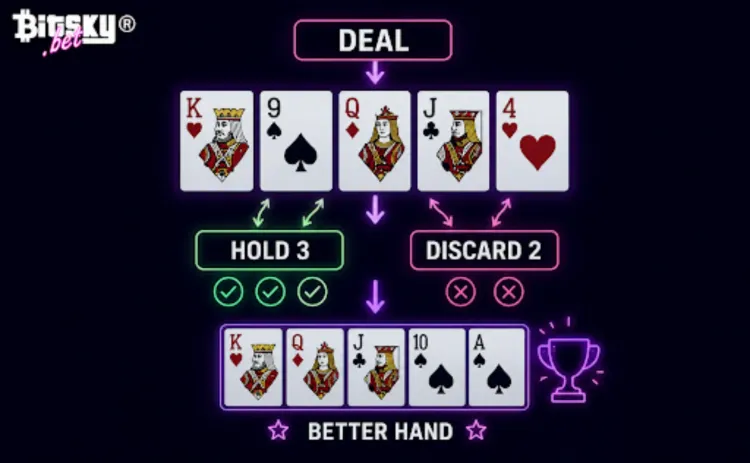
New players often make the mistake of holding on to unrelated high cards out of habit, thinking a face card might turn into something. In most cases, that instinct works against the math. The best way to get better fast is to learn to use the right grip even if it seems wrong.
Basic Video Poker Strategy for the Most Common Hands
There are a lot of hands that come around frequently. It is better to memorize the right move before the move. These aren't complicated decisions once you've seen them a few times.
- A pat hand like a full house, flush, or straight should almost always be held in full rather than broken apart for a bigger draw.
- Four cards to a flush is more valuable than having just one high card. Because the probability of getting a flush is greater than the slight chance of having one paying card.
- A weak pair like a pair of 6s and 7s is better than three high cards that are not related to each other. Despite seeming boring to have them.
- It makes sense to keep two pairs in Jacks or Better instead of breaking it in search of a four of a kind due to low odds of making it.
How Strategy Shifts Across Game Variants
All video poker games don't necessarily follow the same rules; in fact, this is one of the many mistakes that most people make while playing video poker. There are different payback percentages for different games such as Jacks or Better, Deuces Wild, Bonus Poker, and Double Bonus.
Deuces Wild shows this best. Every two in the deck becomes a wild card, which rebuilds the entire hand from the ground up. Take a hand that would be nothing special in Jacks or Better. Drop a couple of wild deuces into it, and suddenly it's one of the stronger hands you'll see all night. That's the catch with basic video poker strategy: what works in one game can actively work against you in the next if the rule differences go unnoticed.
Therefore, before playing your first five cards, it is worth finding out what exactly you have decided to play. You should check the payout table, learn what bonuses are offered by this type of hand, and use it in the game. The underlying logic carries over between variants, sure, but the specific cards worth holding onto change every time the ruleset does.
Bankroll and Session Discipline
Strategy isn't only about which cards to hold. It's also about how you manage your credits across a session. Setting a limit before you start, and sticking to it, protects you from chasing losses or walking away from a winning streak too early out of nerves.
An important aspect of video poker strategy that often gets overlooked is "pacing." Playing too quickly can result in making decisions based on instinct rather than thinking about them, whereas playing too slowly may mean losing opportunities for getting enough plays to prove your strategy worthwhile. A proper balance that allows you to stay focused on each and every play is generally more productive than rushing through the game.
If you're building up your play balance, Bitsky currently offers 20% off purchases when you use 0.20 SC and 20,000 GC with the promo code BONUS4U, which is worth checking before you start a new session.
Speed of Play and Why It Matters
Video poker moves fast, especially once you're comfortable with the hold decisions. This can be a boon or bane to you depending on your attitude towards it. Moving fast without planning each hand effectively negates the strength that you can derive from having the proper grips from the start.
It is not about playing cautiously but rather allowing some time for every hand before making any final decision. Over the long gameplay, this little pause results in fewer errors and a better understanding of how your bankroll is going.
Common Mistakes That Undo Good Play
Even players who have all the basics in hand often get into a habit that unknowingly sabotages their efforts. Identifying these kinds of things is no less important than learning the right moves themselves.
- Chasing a royal flush by breaking a guaranteed paying hand, which usually costs more in the long run than it earns.
- Ignoring the paytable differences between machines and assuming every version of a game pays the same.
- Holding kicker cards out of habit rather than following the actual odds for that hand.
- Playing without a session limit, which makes it easy to lose track of how much has been spent.
Basic video poker strategy exists specifically to correct these habits. Once you notice yourself repeating one of these patterns, it's usually a sign to slow down and reconsider the hold you're about to make.
Building the Habit Over Time
Getting used to video poker strategy is not an overnight process but requires repeated effort and learning from experience game outcomes. It also requires changing one's mindset about each hand depending on what one learns. Those who continue to play will get used to their decision-making after some practice time and will be able to have fun instead of constantly questioning themselves.
Conclusion
Video poker is really about making several small but smart choices. It involves the use of knowledge of pay tables and holds, and discipline during the session. There is no need to memorize any difficult math right away; all that needs to be done is to study the patterns and follow them. This approach will make it possible for people to tell the difference between players who have successful sessions and those who simply spend all their money without knowing why.
Ready to test your strategy? Play video poker on Bitsky.
FAQs
Does video poker strategy actually work?
Yes. The cards are random, but your holds aren't. That's the part strategy controls.
What's the best video poker game for beginners?
Jacks or Better. Simple rules, predictable holds, and it's on almost every platform, so there's plenty of room to practice.
Why does the same hand need a different hold in different games?
Different games pay differently for the same cards. Deuces Wild turns twos into wild cards. Bonus Poker rewards certain four of a kind more. Change the payout, change the correct hold.
How do I know if a paytable is good?
Look at the full house and flush numbers. Something like nine and six signals a strong version of the game. Lower numbers usually mean a weaker payout structure.
How fast can someone learn basic video poker strategy?
Faster than expected. A handful of sessions is usually enough to recognize the common hands and stop second-guessing every hold.