
Why does one slot pay out constantly in tiny amounts while another sits quiet for fifty spins and then hits? RTP, volatility, paylines, and scatter symbols. Most players notice this slot machine terminology on the game's info pages and move on without a second thought. Skipping past them means missing the actual mechanics running underneath everything happening on screen. This article explains what each one means on a sweepstakes platform and how they show up once the reels actually start spinning.
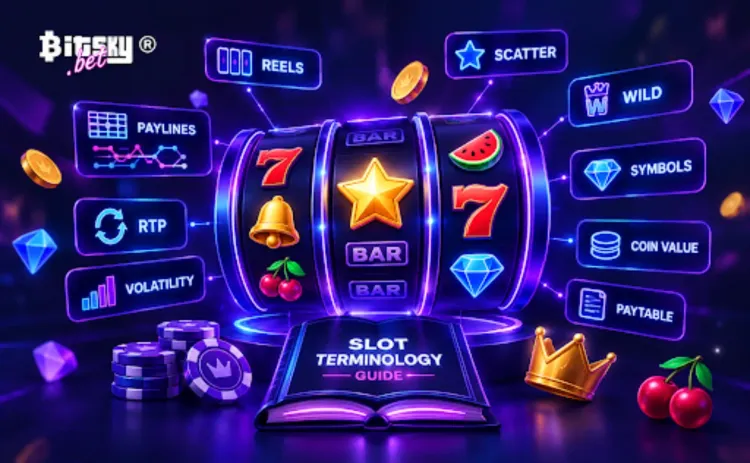
Why Slot Machine Terminology Matters
Start with the reels. They decide which symbols can land in the first place. Paylines come next, setting the pattern a combination has to follow to count as a win. Most players ignore the term "volatility," but it is one of the important terms. It controls how payouts get spread across a session. RTP gets more attention since it estimates how much value comes back to players over time, but on its own it barely tells you anything. Two games can post the exact same RTP and feel nothing alike once volatility gets factored in. One pays small and often. The other makes you wait.
Core Terms Every Player Should Learn First
A few terms show up in almost every slot title. Learn these first, and the rest of this guide gets a lot easier to follow.
- Reels: the vertical columns that spin and display symbols after each round
- Paylines: the patterns across the reels where matching symbols need to land for a win
- RTP (Return to Player): the theoretical percentage of spin value returned to players over time
- Symbols: the icons on the reels, including standard, wild, and scatter types
- Coin value: the amount assigned to each coin in a spin, which affects payout size
- Paytable: the in-game chart showing what each combination pays
- Session: the stretch of time a player spends actively spinning a given title
- Feature round: a general term for any bonus sequence separate from the base game, regardless of what triggers it
Understanding Reels, Paylines, and Symbols
Reels and paylines work as a pair. Most modern titles run five reels, though three-reel formats still exist for players who want something simpler and closer to the old mechanical machines. Paylines are the patterns- straight, zigzag, or diagonal- where matching symbols need to land. Some games lock the paylines in place for every spin. Others let you adjust how many are active before you start. A smaller group of grid-based titles skip paylines altogether. Instead, they pay out on clusters of matching symbols anywhere on the screen. This is usually called a cluster pay or ways-to-win system.
Wild and Scatter Symbols Explained
Wild symbols play a big role in most slots. If you're missing one symbol for a win, a wild fills that spot and completes the combination. Scatters work differently. They don't care where they land. Enough of them anywhere on the screen, and they pay out or trigger a bonus round on their own. Some games use expanding wilds. These grow to cover a whole reel once they land. These stay in place for a few spins instead of disappearing. The game’s type is a good clue for what the bonus round will look like.
Common Slot Machine Formats
Slots generally split into four formats, though most players only interact with two of them regularly. Three-reel slots are the classic setup, with fewer paylines and simpler symbols, closer to the original mechanical machines. Video slots took over from there. A fifth reel was added, more paylines came with it, and bonus features became standard, which is roughly what most people picture when they think of a modern slot today.
Grid-based titles work differently. Rather than spinning reels, they run on a fixed grid of rows and columns, and wins usually come from clusters of matching symbols instead of lines. Progressive titles sit in a category of their own, since the top payout keeps climbing rather than staying fixed. That growth changes how a player might approach denomination or spin size before committing to a title.
Volatility and Payout Frequency Terminology
Volatility tells you how often a slot pays and roughly how big those payouts run compared to the spin value. Low-volatility games pay small amounts often. If you want a steadier, more predictable session with fewer long droughts, that's the category to look at. High-volatility titles pay less frequently, but the payouts run bigger when they land, and that trade-off appeals to players who don't mind waiting for it. Medium volatility sits in between. For a deeper look at this, we broke it all down in our guide to slot volatility.
Provider matters here too. Volatility labels are not perfectly standardized across providers. Two titles carrying the same rating can still spin very differently, mostly because each provider calculates and rounds the figure its own way. A game's specific paytable is still worth checking, even once the general terms are familiar.
Hit frequency is a related term, and it's worth knowing. It measures how often a spin pays out at all, regardless of size. A title can have a high hit frequency and still pay small amounts most of the time. The opposite happens too: rare wins that pay considerably more. RTP, volatility, and hit frequency work together, and reading all three tells you far more than RTP alone ever will. Most game info panels list these figures directly, though the wording shifts slightly depending on the provider.
Bonus Round and Feature Terms
Bonus features are where slot machine terminology gets messy, mostly because providers love giving their mechanics unique names even when the function underneath is nearly the same. Our review of the Dragon Age slot covers its Gold Respin mechanic, which fits a wider trend of respin-based bonuses across the genre. Mine Gems does something different entirely, running a 5x12 grid instead of standard reels. Here are the bonus terms you're most likely to run into:
- Free spins: a set number of spins at no additional coin cost, often with added multipliers
- Multiplier: a value that boosts a payout, sometimes stacking across several wins
- Respin: one extra spin triggered by a specific symbol combination, replacing only part of the reel set
- Cascading reels: winning symbols disappear, and new ones drop in to take their place
- Bonus buy: a feature on some titles letting players pay directly for entry into a bonus round
- Grid-based mechanic: a layout, like the one in Mine Gems, that swaps standard reels for a fixed grid
A Few More Terms Worth Knowing
A handful of other terms are worth knowing too, especially as you start exploring Bitsky's library:
- Auto-play: runs a set number of spins automatically; no manual input needed
- Turbo spin: speeds up the reel animation between rounds
- Max win: the highest possible payout a single spin can produce, shown as a multiple of the spin value
- Anticipation effect: a visual cue that flags when a bonus-triggering symbol is close to completing a combination
- Stake level: a separate setting from coin denomination that scales the total value of a spin
Coin Values, Denominations, and Spin Costs
New to spin value and denomination? Start small. Running lower denominations while you're still learning a title's paytable and bonus triggers costs you far less than jumping straight to a higher spin value on a game you haven't tested yet.
Every slot lets you adjust how much a spin costs, and the terms around this trip people up more than they should. Coin denomination is the smallest unit of value in a game, sometimes as low as one cent on entry-level titles. Low-tier denominations stretch a smaller balance across more spins. Higher denominations raise both the cost and the potential payout size. Spin value, sometimes called stake value elsewhere, is the total amount applied to one spin once coin denomination and active paylines are combined.
Adjusting these settings is one of the easiest ways to shape how a session goes. Players who want more spins per session usually drop to a lower denomination. Players chasing bigger potential payouts raise the spin value instead. Most titles show the current coin value and total spin cost right above the reels, so switching between rounds doesn't require digging through a menu.
Putting the Terms to Use
Knowing the terms is one thing. Using them to pick a title is another. RTP alone does not tell the full story. It matters more when read alongside a game's volatility rating, since identical RTP numbers behave completely differently depending on whether a title runs high or low volatility. The paytable adds the rest of the picture, showing which symbols carry the largest payouts and giving a sense of how the bonus round actually functions. Together, these details are usually enough to judge whether a game is worth your time before a single reel spins.
How Bitsky Uses These Terms Across Its Game Library
Bitsky's library covers every volatility level and reel format mentioned in this guide, from low-volatility three-reel classics to high-volatility grid-based titles. A few other features help players build up Sweeps Coins and Gold Coins while they get comfortable with everything covered above:
- Task Rewards: Earn Sweeps Coins and Gold Coins by completing specific in-platform activities
- Spin the Wheel: Bronze, silver, and gold wheels, each with a different range of SC and GC prizes.
- Daily Rewards: a recurring bonus for players who log in regularly
- Promo Code feature: a general system for redeeming additional codes beyond the welcome offer
- KYC verification bonus: complete identity verification and earn up to 10,000 GC and 2 SC
- Email and SMS opt-ins: additional ways to receive free Sweeps Coins through platform communications
Conclusion
Slot machine terminology looks intimidating from the outside, but it stops being confusing the moment you break it into pieces. Reels, paylines, volatility, and bonus mechanics- it's all connected, and once the terms make sense, choosing a title that fits what you want gets a lot easier. Bitsky's library gives you plenty of formats to put this knowledge to use, along with a welcome offer and several ongoing ways to earn Sweeps Coins and Gold Coins. Next time you open a new title, none of this should feel foreign. You can just focus on the game.
Ready to put your slot terminology knowledge into action? Explore the Bitsky casino now, browse the game library, and find your next slot to play.
FAQs
What's the difference between spin value and coin denomination?
Coin denomination is the base unit, and spin value is the total once that unit gets combined with paylines and coin count. Changing your denomination is usually the fastest way to change your total spin cost.
What is RTP in slot machine terminology?
RTP, or Return to Player, is the theoretical percentage of spin value a game returns to players over a long stretch of rounds. It's calculated across millions of spins, so it won't predict what happens in any single session you play.
What does volatility mean in a slot game?
Volatility tells you how often a game pays and how big those payouts tend to run relative to spin value. Low-volatility titles pay smaller amounts more often. High-volatility titles pay less frequently but hit bigger when they do.
What is the difference between a wild and a scatter symbol?
Wilds substitute for other symbols to help finish a combination. Scatters usually trigger a payout or bonus round no matter where they land, since they don't need to follow a payline at all.
How can new players use this terminology on Bitsky?
Knowing terms like RTP, volatility, and paylines makes it much easier to compare titles across Bitsky's library before picking one. New players can also claim 131% more on their first purchase and get 20% off purchases with 0.20 SC and 20,000 GC using promo code BONUS4U.
Authored and Validated By: A Sweepstakes Gaming Expert