A single spin. A number on the screen that hasn't stopped climbing in weeks. And somewhere, a player is about to watch it reset to zero the moment it lands in their favor. That's the pull of progressive jackpot slots, prizes that grow with every round played until one lucky spin claims the lot. What makes the format so compelling isn't just the size of the prize but the uncertainty behind it, nobody, including the platform itself, knows exactly when that number will drop. For some players, that's the entire appeal; for others, it raises fair questions about how the system actually works.
What Exactly Is a Progressive Jackpot Slot?
In contrast to the fixed-prize game, where the highest payout is predetermined and doesn’t change regardless of the length of time spent playing, the progressive jackpot slots rely on an accumulating total. A certain fraction of the game activity goes into a common pool of money, which increases until it is won by one of the participants. After that moment, it usually returns to its initial value and starts accumulating anew.
Three basic types of progressive instant win formats can be identified among the existing online systems:
- Standalone progressive: connected to only one specific game; the pool increases only because of the usage of this particular title.
- Local progressive: connected to a limited set of games, often by the same provider; a somewhat faster-growing pool compared to the standalone type.
- Networked (wide-area) progressive: connected to many different games, including different platforms; this is what makes the pools grow to the highest numbers.
All three types share the basic concept: the more players using the game, the bigger its prize pool gets.
Why Players Search for Answers Before They Play
Anyone who's watched a jackpot counter tick upward has probably asked a version of the same questions. Is the number really random, or is there a pattern? Does playing longer improve the odds? Is a jackpot "due" after sitting untouched for a while?
These aren't unreasonable questions, they come from wanting to understand something before putting time or money toward it. And the honest answer is that progressive jackpot games run on a Random Number Generator (RNG), a system that produces an unpredictable result on every single round, independent of what happened before it. There's no internal memory keeping score of how long it's been, no countdown ticking toward an inevitable win. Each round stands entirely on its own.
What Makes Progressive Jackpot Slots So Appealing
Despite the uncertainty, progressive-style games remain some of the most searched and most played instant-win formats online, and it's not hard to see why:
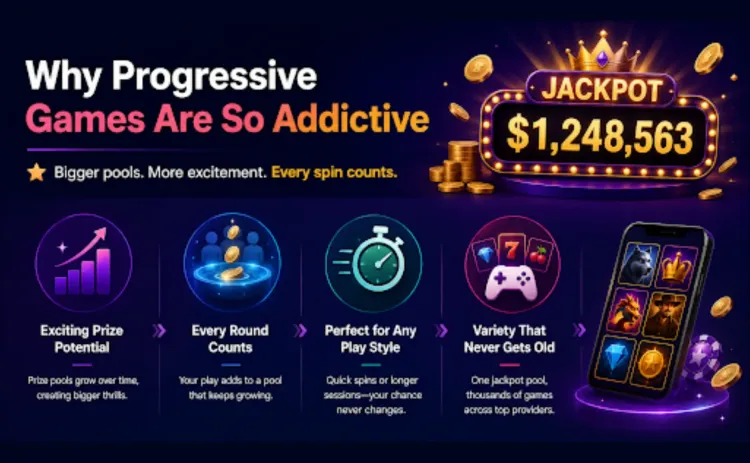
- The prize potential feels different. A pool that's been climbing for days or weeks carries a different kind of excitement than a fixed, unchanging prize.
- Every round counts toward something bigger. Even casual play contributes to a pool that keeps growing in real time.
- The format works well for both quick sessions and longer ones. There's no need to commit extra time to stay eligible for a shot at the growing prize.
- Variety keeps things fresh. Networked jackpots often span dozens of games, so players aren't locked into one single title to chase the same pool.
On a platform like Bitsky, this variety is part of the draw, with thousands of titles from dozens of providers, players have plenty of jackpot-style and instant-win options to explore without needing to stick to just one game.
Who Can Actually Take Part?
The progressive jackpot games on the sweepstakes platform are not bound by any specific level of skill, and this is one of the reasons why these sweepstakes tend to have such a huge player base. Nevertheless, there are a few things that should be known:
- Players usually need to be of legal age, 18 years old or older (21 years old and up in some states).
- Physical location plays a role as well, participation in sweepstakes is prohibited in some regions and states.
- Identity verification (KYC) is usually needed for prize claims.
On Bitsky specifically, getting started doesn't require a purchase at all. New members will earn 10,000 Gold Coins (GC) and 1 Sweeps Coin (SC) just by signing up, whereas verifying their identity gives them an extra reward of 10,000 GC and 2 SC. Gold Coins serve as pure entertainment currency, whereas Sweepstake Coins serve as the currency that holds the true value of sweepstakes entries and thus allows users to earn prizes without making any purchases at all.
How the Jackpot Pool Grows and How It Pays Out
Here's where the actual mechanics come in, broken into the two halves that matter: how the number climbs, and how it's eventually triggered.
Growing the pool: A percentage of activity across the connected games feeds directly into the jackpot total. This happens automatically and continuously, which is why the number rarely sits still for long on a popular title. The more players engaged with a linked network of games, the faster that pool tends to climb.
Triggering a win: There are two common ways a jackpot gets released:
- Random trigger: The system's RNG can select a jackpot outcome on any qualifying round, with no specific symbol combination needed.
- Bonus or combination trigger: A particular symbol pattern, or entry into a bonus feature, opens the door to a jackpot outcome.
Because the total prize pool is larger than a standard payout, the odds of triggering it are intentionally lower, that trade-off is part of what allows the number to grow so large in the first place. It's also worth noting that coin type, minimum activity thresholds, or specific game rules can affect eligibility for a jackpot outcome, so it's worth checking a game's individual rules before assuming every round automatically qualifies.
Where the Format Runs Into Limits
Progressive jackpot games are entertaining, but they come with a few limitations worth understanding upfront rather than discovering later:
- Odds get tougher as pools get bigger. A larger total generally means a rarer trigger, there's no way around that math.
- Eligibility rules vary by state. Sweepstakes participation is void where prohibited by law, and some states carry additional restrictions.
- Redemption always requires verification. No platform can process a payout without confirming identity first, this protects both the player and the platform.
- Streaks and timing don't influence outcomes. Because each round is independently randomized, there's no strategic pattern that improves results.
None of this makes the format any less enjoyable, it just means the appeal should be understood as entertainment with a real chance at a prize, not a guaranteed formula.
What Redemption Actually Looks Like
Once players who qualify actually manage to get their Sweeps Coins wins, the procedure will follow certain stages that are well defined, namely, confirmation of the win, verification of identity (if not done yet), and finally, the win will be cashed out via usual methods of payment, such as debit cards, bank transfers, or gift cards, among others. In some cases where the payment processes work efficiently, the above can take place over a short period instead of taking several days.
Progressive Jackpots vs. Fixed-Prize Games: A Quick Comparison
It helps to see the two formats side by side rather than in isolation:
- Prize size: In the case of fixed-format games, there is an exact, guaranteed prize offered every time, whereas with progressive-format games, there is a growing pool of prizes that can grow much higher than a fixed prize.
- Odds: In fixed-prize slot machines, there is a stable probability that comes with the game, while in the progressive format, the probability is sacrificed for a high reward.
- Pacing: Fixed-format slots pay out frequently but in smaller amounts compared to progressive jackpot slots that pay out occasionally but in a larger amount.
- Player appeal: Fixed games suit players who prefer consistency; progressive games suit players drawn to the anticipation of a rising number.
Neither format is objectively "better"; it comes down to what kind of experience a player is looking for on a given session.
A Realistic Look at How This Plays Out
Consider a player who signs up on a sweepstakes platform, claims their welcome coins, and spends a few sessions across different instant-win titles over a couple of weeks. Most rounds land as expected, some small wins, some nothing. Then, during one ordinary session on a networked jackpot title, a bonus round triggers, and the pool that had been quietly climbing for days pays out in full.
Nothing about that session looked different from any other beforehand, no unusual pattern, no long losing streak that "predicted" the win. That's the nature of RNG-based systems: the outcome is unrelated to anything that came before it, and the trigger can happen on a completely ordinary round.
Getting the Most Out of Your Sessions
For players who do choose to top up their coin balance, it's worth knowing that Bitsky currently runs a 20% bonus offer on qualifying purchases of 0.20 SC and 20,000 GC using the code BONUS4U at checkout. It's a straightforward way to stretch a purchase further, though it's worth repeating that no purchase is ever required to participate in the sweepstakes or to redeem Sweeps Coins. Free entry methods(AMOE) remain available to every player regardless of purchase activity.
Conclusion
Progressive jackpot slots operate on an uncomplicated principle hidden behind a very interesting presentation: the pool of money builds up through play, a random number generator determines when to distribute it, and no matter how much you try to predict the exact moment for the distribution, you can’t succeed. The only thing you have to understand is the way these things work. If you're curious to see how these games actually feel in practice, exploring a sweepstakes platform's game library with the free coins available at sign-up is a low-pressure way to find out.
The next big pool could be one spin away. Join Bitsky now and claim your welcome coins, no purchase required.
FAQs
1. Does the progressive jackpot slot machine begin from scratch once someone wins the jackpot?
Yes, when the jackpot is won, the total amount usually goes back to a predetermined initial amount called the seed and starts rising again from there.
2. Could I predict whether a progressive jackpot is near its pay-off from the number on display?
Not really. The number displayed is a measure of how much has been invested into the pot; it does not determine proximity to victory since wins depend on an RNG. This means that the chances of winning don't increase just because the jackpot's number is very large.
3. Do all games linked to the jackpot have the same probability of activating it?
No. The individual rules of each game, the minimum number of coins, and play conditions may vary; thus, the possibility of both games being able to activate the jackpot is not the same.
4. Do I have to play a certain minimum amount in order to be eligible for a jackpot win?
That is dependent upon the rules of the game itself. There are some games that require a certain type of coin or level of entry in order to be considered eligible for a jackpot prize.
5. What is the time period required for processing the winnings once the Sweeps Coins are redeemed?
The time taken will depend upon the platform being used and the completion of the KYC process, but there are certain platforms that process the redemption process quite quickly.
Authored and Validated By: A Sweepstakes Gaming Expert